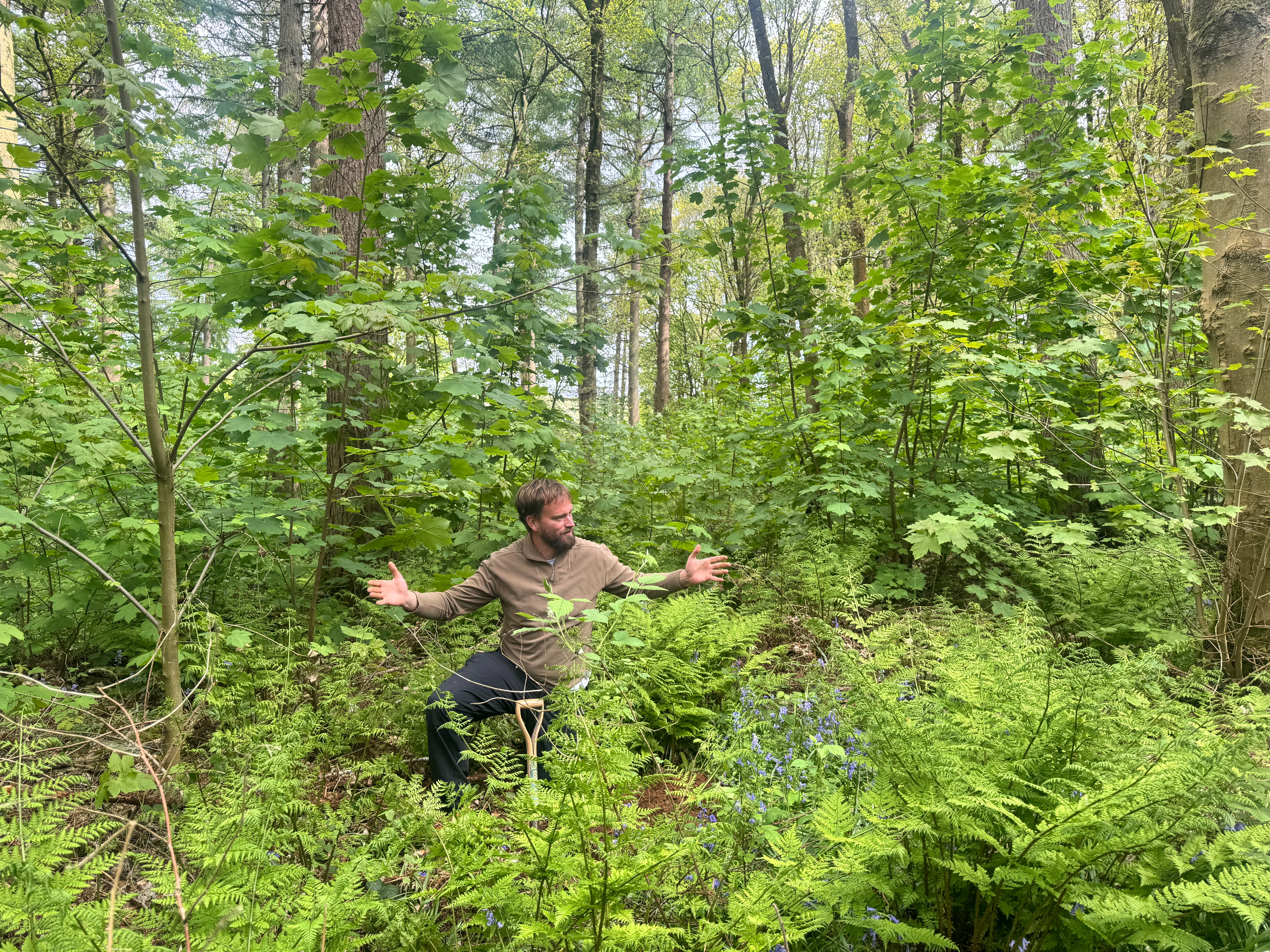
Your woodland is changing whether you're managing it or not. The question isn't whether it will be resilient, it's whether you'll take action to make it resilient.
Most woodland owners think about resilience in abstract terms; climate risk, pest pressure, long-term viability. But resilience is built on the ground, through specific choices about how your trees live together. And those choices have a direct financial consequence.
Woodlands are important, but why is your woodland important to you? You might value timber income, or standing timber value. You might care about wildlife and ecology. Maybe public access, or carbon storage, or a reliable supply of firewood for your farm. Perhaps it's shelter from wind, or the simple fact of big trees and beauty on your land. Whatever draws you to your woodland, whatever you've valued in it or hope to get from it, that value is under threat without resilience. A woodland that's undermanaged, reliant on a single species, or simply left to its own devices becomes vulnerable to the forces that undermine everything you care about.
From Resilience to Value
Here's where perception shifts. Many owners see resilience work as a cost: thinning, species diversification. But when resilience is built properly, it increases the value of your woodland through financial flexibility and longevity.
A monoculture means a narrow window of opportunity for harvesting. Miss it and the stand becomes vulnerable to wind blow. Furthermore, because everything is one species, a pest or disease outbreak isn't just a problem, it's an economic threat to the entire woodland. You're not in control of when that happens. Pests, diseases, and storm events arrive on their own schedule, not yours. You've surrendered control to forces beyond your management. You can't wait for markets. You can't choose your moment.
A resilient woodland does the opposite. By building structure and species diversity, you create a framework of quality trees that you can harvest selectively and on demand. You're not racing against biological time. If the market isn't asking for what you've got, you hold it. If markets shift, you respond with the species you've already established. Those quality trees (crown-thinned and high-pruned early) form the long-term productive core, supported by younger regeneration underneath. You always have timber available, always have options, and you're never forced to harvest into a poor market just to beat the clock. That's financial resilience. That's the value.
The Case for Active Management
The way to guarantee resilience is through active, informed intervention. You can trust natural processes; that's a legitimate approach, and forests may become resilient over time. But if you want to guarantee resilience and deliver your woodland's objectives within your lifetime, strategic management designed around your site's specific conditions is how you get there.
Understanding what species your site can support matters. Strategic thinning creates space for younger trees and light-demanding regeneration. Making room for new species (particularly those better adapted to hotter, drier conditions than your current stock) shapes how your woodland responds to change.
This is where the distinction between informed management and generic work becomes crucial. Poor planning around thinning can result in wind blow and prove costly. Planting the wrong species for your soil, aspect and climate results in slow growth rates and higher susceptibility to threats. Informed management uses evidence. It starts with a woodland management plan that understands your specific site conditions and sets out a coherent sequence of actions.
CWS5 as Funding Mechanism
Which brings us to how this gets funded. In England, applications for woodland management through Countryside Stewardship Higher Tier agreements opened in 2025. Within it sits a specific supplement action designed for exactly this work: CWS5, Improve Woodland Resilience.
CWS5 pays £202 per hectare per year, across a ten-year agreement. You must combine it with the CWD2 base action (Woodland Improvement), and you must have a Forestry Commission-approved woodland management plan in place. The minimum application size has been reduced to 0.5 hectares, which opens access for smaller woodland owners who were previously excluded.
The payment structure means a ten-hectare woodland in active resilience management generates £3,290 in annual payments from CWD2 and CWS5 combined - enough to fund the additional costs of management. More importantly, CWS5 funds the expertise and analysis that make resilience management work. The thinning, felling, and timber sales should largely pay for themselves. What the grant covers is the professional time required to assess your woodland properly, design a bespoke management programme tailored to your specific conditions, and execute it with the precision that builds genuine resilience rather than generic intervention.
What CWS5 Demands
The scheme is not a subsidy for passive ownership. It funds a specific set of actions, agreed between you, your agent, and your Forestry Commission woodland officer, laid out in your ten-year agreement and grounded in your approved management plan. Those actions (whether marking thinnings, identifying quality trees for retention, managing complex harvesting sequences, or underplanting) require professional expertise to execute properly. CWS5 pays for that expertise and analysis. The funding covers the professional time to assess your woodland, design the bespoke management program tailored to your specific conditions, and oversee its implementation with the precision that separates genuine resilience building from generic intervention.
Your Woodland's Present Shapes Its Future
The deeper point is this: you already own a woodland with specific conditions, history, and constraints. That woodland is either becoming more resilient or less resilient through whatever is happening to it right now. There is no neutral.
Active management directed by a clear plan, funded through CWS5, is how you take agency over that trajectory. It's not a theoretical exercise in climate adaptation. It's a practical choice to build value (ecological, financial, climate) in the thing you already own.
That begins with understanding what you have, and what it can become. If you're sitting with a woodland that's been left to itself, or inherited simplified management from a previous owner, the first step is straightforward: get a proper assessment. A Forestry Commission-approved woodland management plan isn't bureaucracy, it's a document that translates your specific site into a coherent strategy. It identifies your soil type, aspect, existing species composition, structural gaps, and the opportunities that are already there. It answers the question: what does this woodland actually want to become?
Once you have that plan, CWS5 becomes the mechanism to fund the work. You're not betting against future conditions. You're working with them. You're building the internal complexity that lets a woodland adapt rather than collapse when conditions shift, and they will shift. The financial case is straightforward too. Ten years of CWS5 payments cover the cost of active management. The timber from thinning and selective felling pays for itself, or better. The resulting woodland is worth more. And you've eliminated the risk that comes with simplified, passive ownership.
Your woodland's future depends on understanding its present. That understanding starts with a plan, and the funding to act on it.